
Losing Richard
A story of resilience

This is the first installment of a new series, Stories of Resilience. Authored by real women of a certain age, few of them are professional writers but all have wisdom to share. Read how they handled a life disruption with strength and hope.
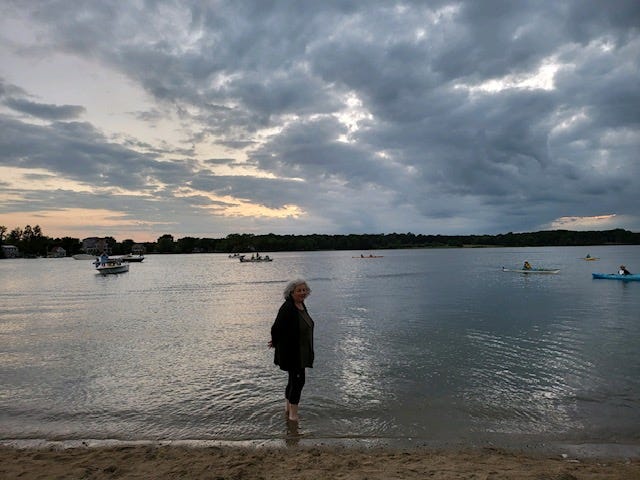
On Sunday I celebrated our 48th anniversary alone.
It has been 33 years since my husband, Richard, passed away.
Not long after he died, a cousin declared, “How lucky you are to have those children! You have something to live for.” I looked at her like she was crazy.
Rich was the at-home parent. He was a compassionate, warm-hearted, playful man, and a good cook. I had advanced to a career job I loved that used many of my talents and allowed me to keep learning, my deepest joy. I had a career I liked and was good at. I was the breadwinner. It had never occurred to me that I would not work. How else did a person have a steady place to live, food, clothes, fun? Not working was a temporary thing people sometimes did between jobs. Rich had another worldview. He was a freethinker: a poet, musician, unlicensed counselor, and freelance journalist. Work was something he did sporadically to support those passions. We had found the perfect partner to live out our ideal parenting dynamic.
The solid foundation we had built vanished overnight when he died of a sudden heart attack. Suddenly it was just me and my two babies.
Our five-year-old son understood that his best friend was gone forever. My daughter was 16 months and 11 days old. Last week, her son, my grandchild, was the exact age she was when Richard died. I observed this tender, trusting grandchild and imagined what it might have been like for his mom, my daughter, to wake up one morning and never again see her other parent.
Somehow, I arranged a funeral. Somehow, I found daycare for the baby. Somehow, I made it back to work after the meager one-week bereavement leave offered from the corporation. One decision at a time, our diminished family moved forward. Intuition, a built-in form of wisdom, guided me one step at a time.
My cousin was right: even though I was numb, taking care of the children gave me a reliable pattern. They needed to eat, so I had to prepare healthy foods every day. I had to put them to bed at a reasonable hour and wake them at a reasonable hour. I needed to do laundry and give baths and read to them. Therefore, I also ate heathy and slept regular hours and had clean clothes, and read funny children’s books. It was a gift to my heart that in losing my love I had these children.
In those first years, my focus was on the kids and on my job. I met other parents, families juggling too many responsibilities. I found my son a therapist, and then a wonderful bereavement group for children. I was in the next room attending a group for guardians to the child who had lost a parent. Until then, I felt like the only person on earth going through this kind of parenting hurdle. When my neighbor friend lost her husband, she joined this group and also found great solace being surrounded by others experiencing similar pain and shock. We are still dear friends, bonded through the decades by both the shared pain and the comfort of the support of others.
In these early years, when the enormity of the loss of Richard felt like it was engulfing me, the loss, as I was able to process it, was about the loss to others – my children, my in-laws, the world which would never benefit from the books Richard would never write, the loss to Richard of the rest of his life. My own sense of loss waited patiently.
At the two-year mark, I took a weekend workshop on recent loss. In that workshop I finally saw: Dee, you lost your husband. Not just your children’s father, not just your mother-in-law’s son; you lost your husband, your chosen life partner, your love.
Around the same time, I recognized I was experiencing stress that could affect my well-being. I struggled at work. After two years of running as fast as I could just to fall farther and farther behind on client visit quotas and other Very Important corporate BS, my employer and I parted company. I used my savings to take a year off. The first week after I finally left the job, I was riding on the bus and started crying. Weeping. Sobbing. For two weeks I rode the bus during my child-free hours and cried. I caught my breath, and slowly exhaled. In that year off, I took career counseling workshops, went to daily twelve-step meetings, went to a gym, and did volunteer work in a library.
When my funds said it was time to work again, I found a position in my same career, but with no overnight travel. I continued to grow in my career, doing continuing education and getting additional certifications so as to keep myself employable and mentally stimulated. Once my children were out of high school, I resumed work travel (which I really liked). Though I changed employers several times, I was able to ride this career to retirement at age 66.
Financial stability has always been very important to me. I wanted to earn enough money to support myself and my family. I wanted reliable health care benefits. This kept me showing up for work for 40+ years, even when I had less than wonderful bosses. I was afraid of debt, so I have lived within my means through my adulthood. There are downsides. This debt-phobia means I never took on a mortgage, so I am still a renter. On the plus-side, both my children graduated college without debt through diligent saving, their working while in school, and taking advantage of public education.
Looking back, what are other themes and lessons?
I see that every day there were forks in the road, and I had to make a decision. I did not need to look too far beyond each decision. In twelve-step programs it is advised to make no big changes in the first year of recovery. This gave me permission to not run away – just keep on keeping on.
I learned to trust my intuition. Sometimes my gut led me to my decision without my mind having a clue why – the day care provider I chose, the decision to stay in my current life and not run home to mama and papa, to not get involved with another person while my children were young. While I never married again, I did love again.
I see no shame in asking for help, especially from professionals such as therapists. I love my current therapist and I love 12-step for myself. My friends and family have been a deep source of emotional support.
Is there advice useful to others? For me, not living beyond my means has worked well, emotionally and financially. I trust my intuition and my higher self while others do better looking at data and weighing pros and cons. Everyone is different and no one way is intrinsically better than others.
Take the time to know yourself. Invest in yourself. Do not be afraid to ask for help.
- Diane, Age 73
If you read this first essay clear to the end, and you enjoyed it, would you please let me know by clicking the heart at the bottom. Thanks. If you or someone you know would like to submit a story for this series, please email me or send me a message via substack.
This was beautiful. I find solace in reading other people's grief stories to learn the similarities and differences to mine. ❤️